Sweetgreen
Employee feedback at Sweetgreen lacked trust and clarity. I redesigned the system to be role-aware and transparent, enabling employees to share their voices and managers to act on insights that boost engagement and retention.
Product Management
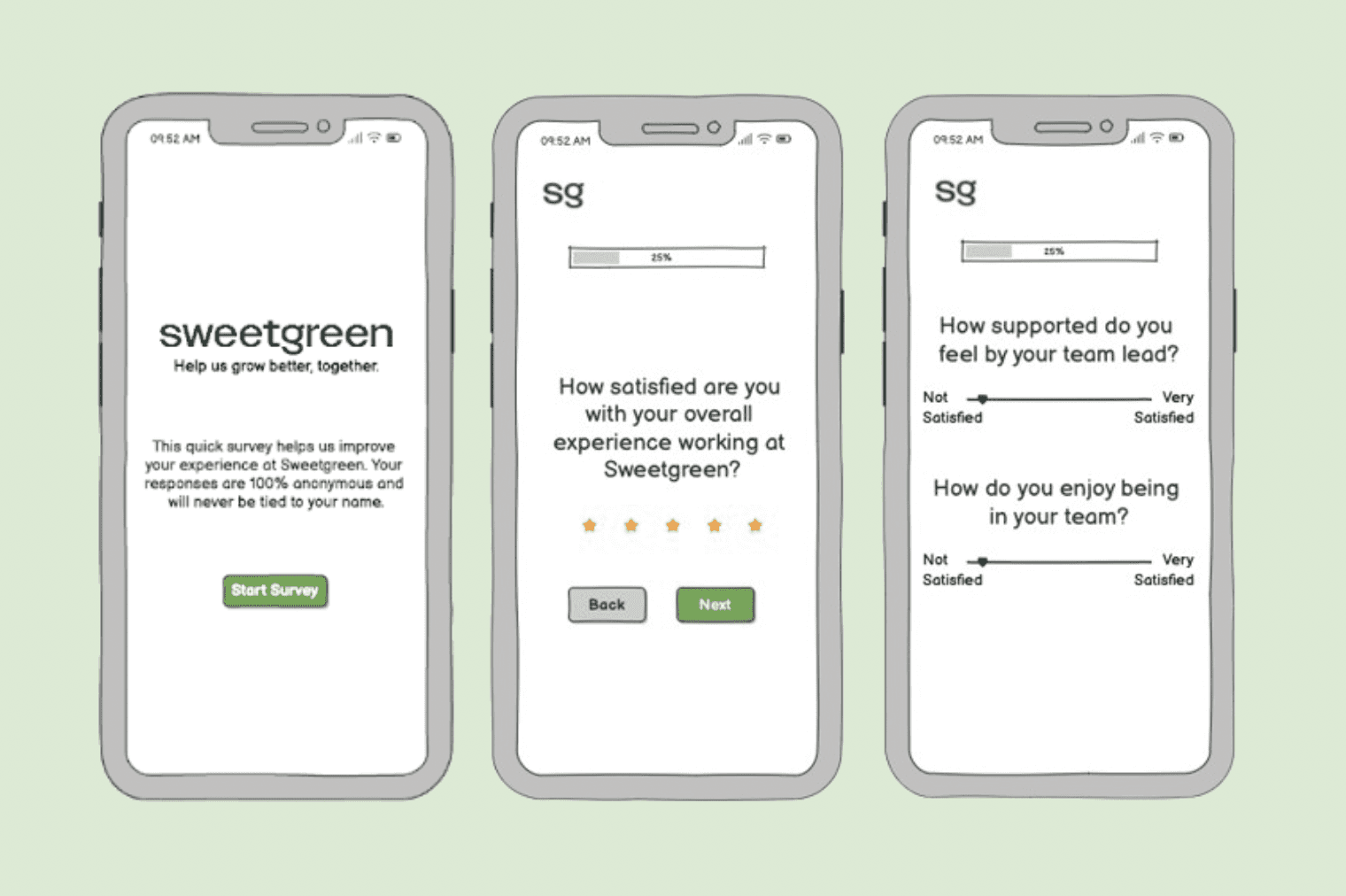
Project Overview
Client: Sweetgreen
Industry: Food & Beverage, Workforce Technology
Timeline: 12 weeks (2025)
My Role: Product Management Consultant
Problem/Context
Restaurant employees often distrust feedback systems that feel impersonal and disconnected from daily workflows, leading to low participation and guarded responses.
Managers, meanwhile, receive vague, unstructured feedback that is difficult to act on, breaking feedback loops and limiting Sweetgreen’s ability to improve engagement and retention.
How might we redesign employee feedback to build trust, increase participation, and drive action?
Research/Insights
Methods:
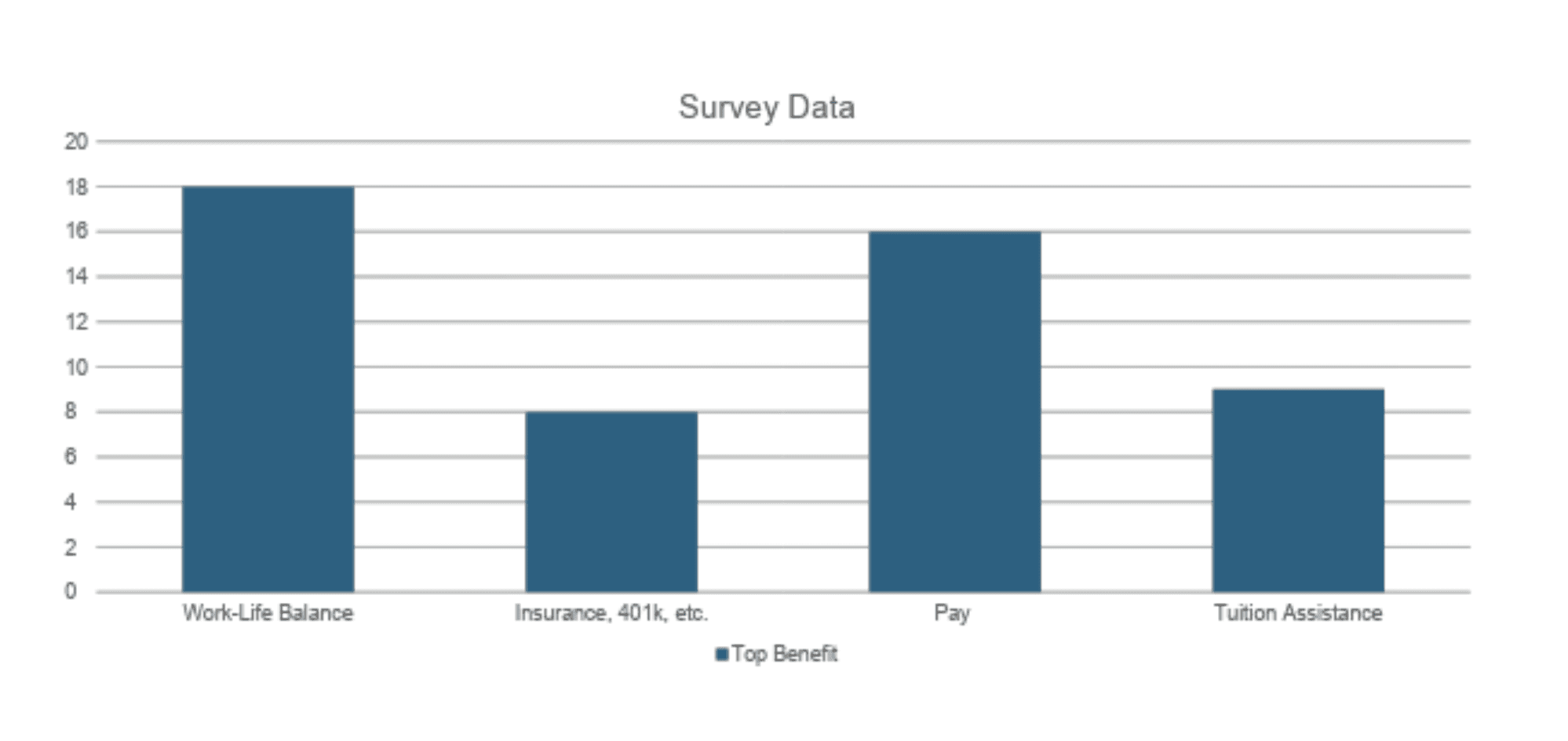
Surveys and focus groups across roles (team members, shift leads, managers)
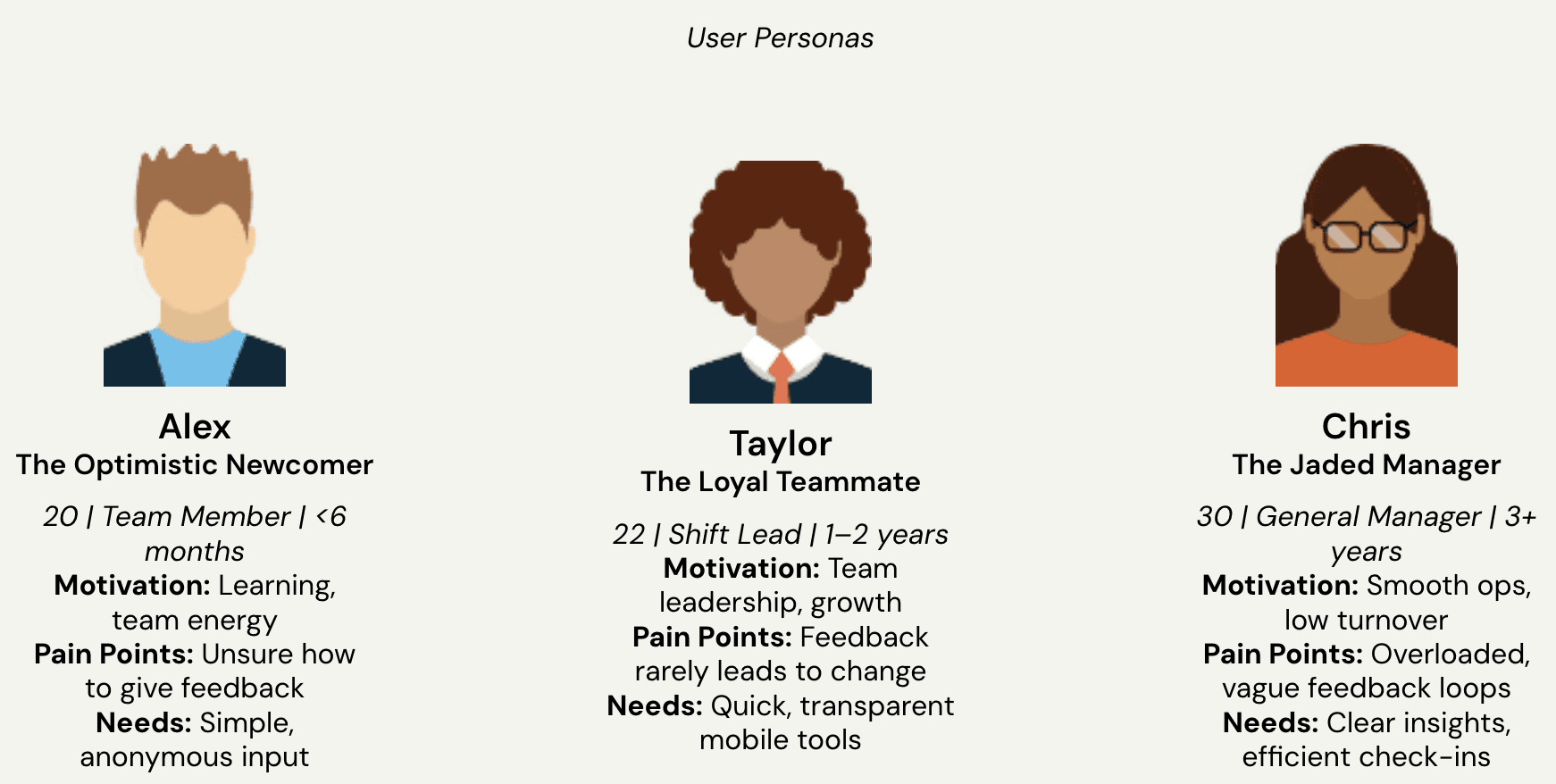
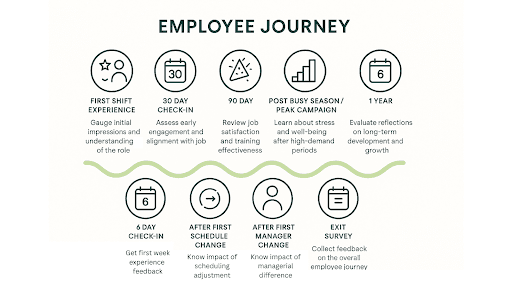
Persona development and journey mapping
Review of internal feedback workflows
Synthesis:
Affinity mapping to identify themes
Role-based personas
Employee journey mapping
Key Insights:
Trust in anonymity is critical for honest feedback
Feedback must visibly lead to action to sustain engagement
Mobile-first experiences drive participation
Short, contextual surveys outperform long, generic ones
Managers need structured, digestible insights
Ideation/Strategy
Ideation Methods:
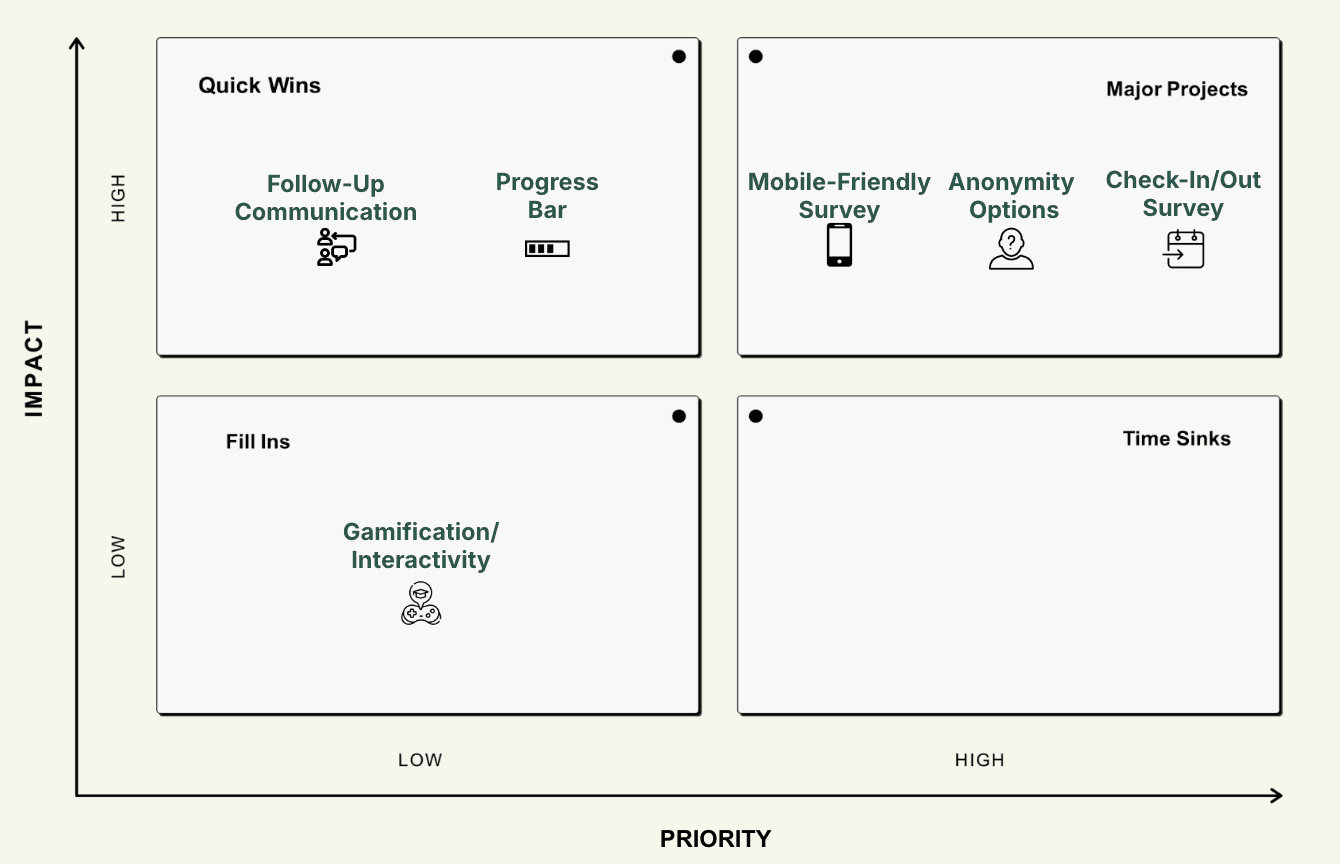
Feature brainstorming and prioritization
Impact vs. effort analysis
MVP definition
Proposed Feature Set:
Mobile-friendly surveys
Anonymous responses
Follow-up communication
Progress indicators
Gamified interactions
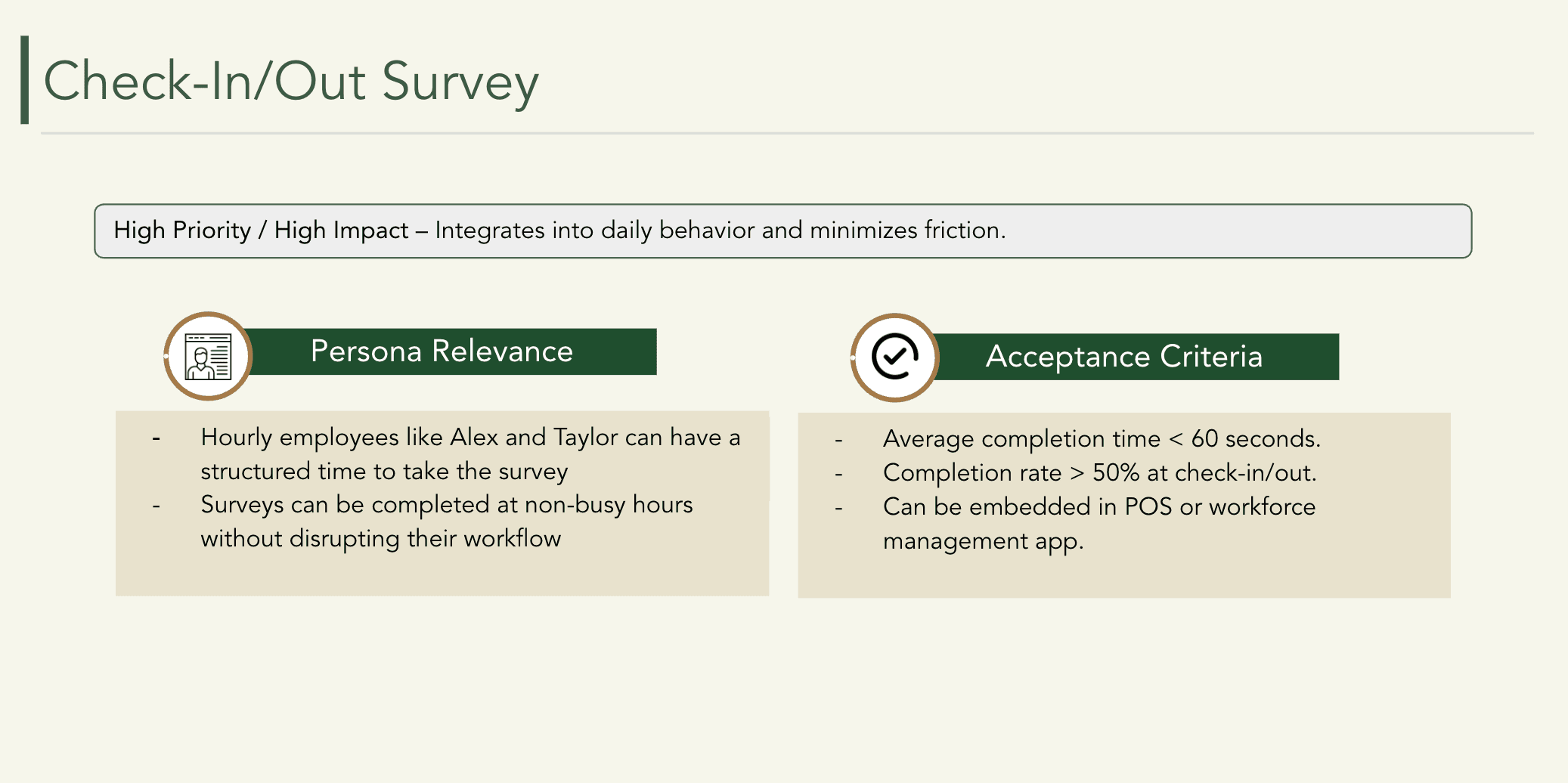
Check-in / check-out surveys
Prototype
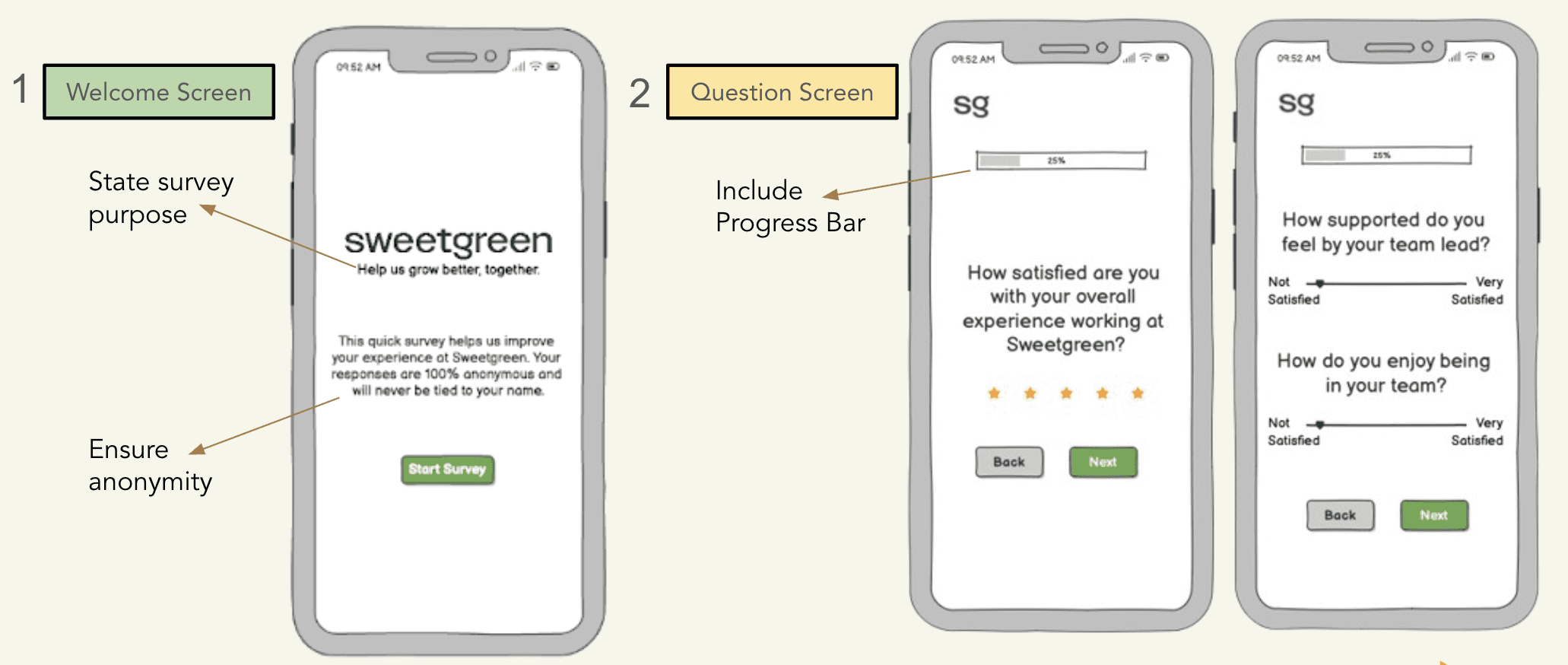
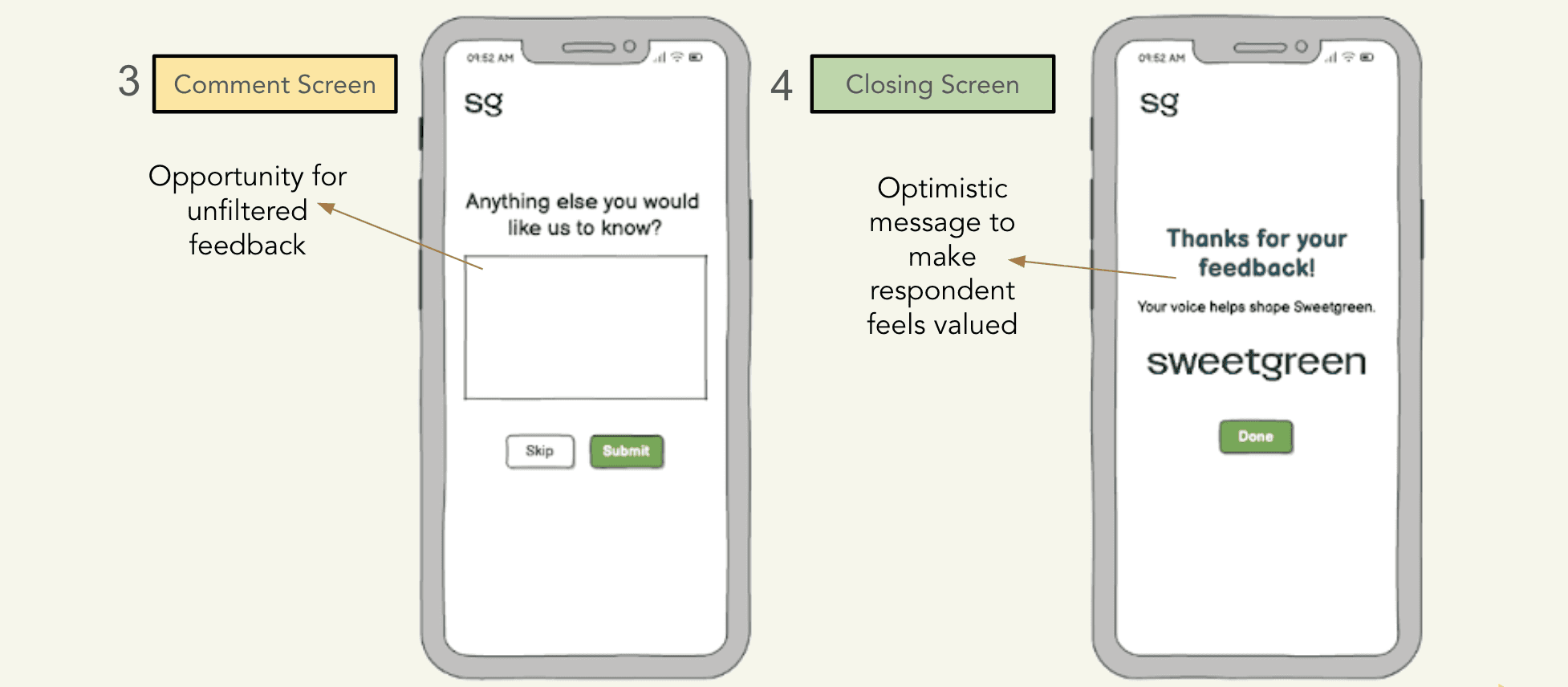
We translated research insights into a feedback system designed around trust, clarity, and ease of use.
Core Components:
Anonymity reassurance at key moments
Progress indicators to reduce fatigue
Clear closing messages reinforcing impact
Validation/Measurement
Success Metrics:
Short-Term Engagement
Survey completion time
Participation rate
Repeat participation
Long-Term Impact
Issues addressed
90-day retention
Promotion and growth signals
Validation Approach:
A/B testing survey formats and scales
Measuring engagement across role types
Implementation/Risks
Phased Rollout:
Phase 1: Trust-building features (anonymity, mobile access)
Phase 2: Engagement enhancements (gamification, progress)
Phase 3: Optimization and scaling
Risks & Mitigations:
Risks | Mitigations |
|---|---|
Low early participation | Extended testing and timing adjustments |
Timeline delays | Milestones and buffer time |
Vendor constraints | Early alignment on must-haves |
Impact/Takeaways
By designing feedback around employee roles and workflows, we positioned Sweetgreen to increase participation, improve insight quality, and strengthen long-term engagement.
This project reinforced my approach to product management: treating employee experience as a product, and using small, intentional design decisions to drive trust, adoption, and impact.